
The START project concludes – Throwback on the deliveries of the project.
Four years of EU-funded research on sustainable thermoelectric materials — from European mine waste to functional devices, with Thermagy contributing at device level.
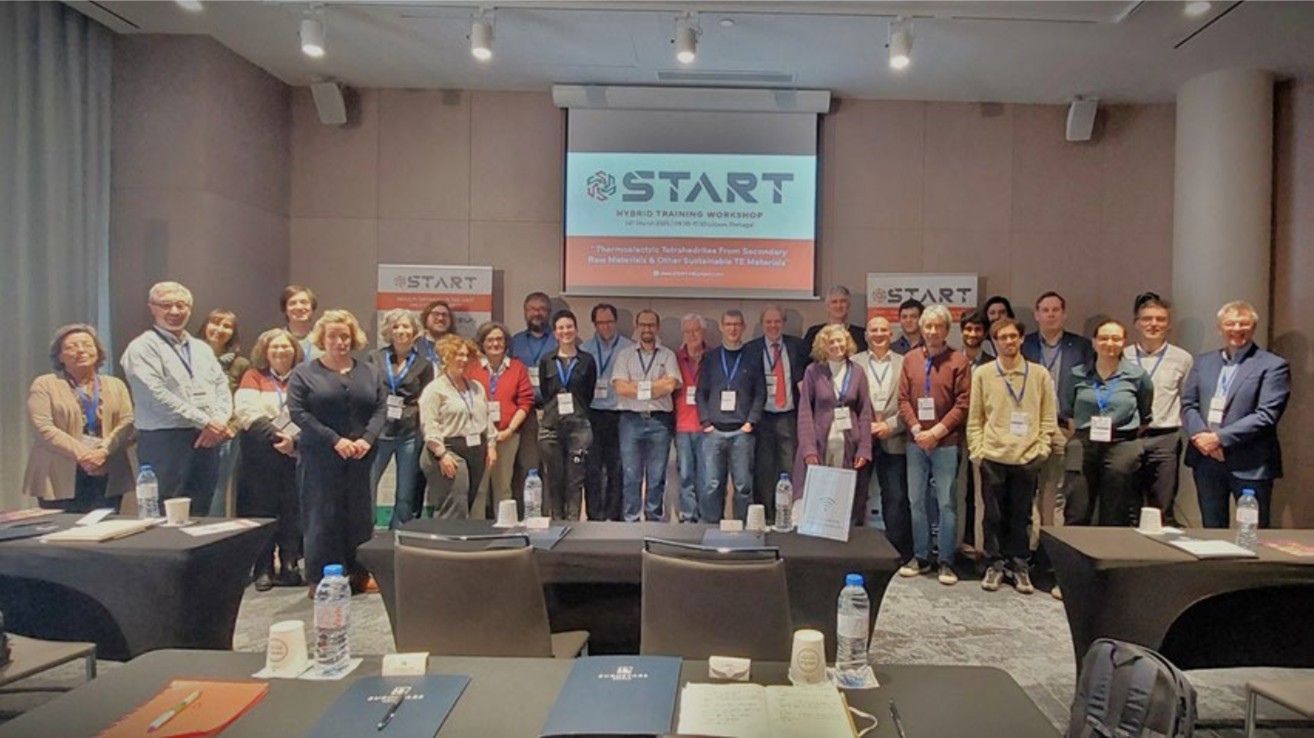
The START project (Sustainable Thermoelectric materials fromsecondary RAw maTerials) has reached its conclusion after four years ofcollaborative research involving 13 European partners. Its central objectivewas to develop thermoelectric generator (TEG) materials and devices based ontetrahedrite — a sulphide mineral recoverable from mine waste — as analternative to conventional bismuth-telluride (BiTe) and lead-telluride (PbTe)thermoelectric materials.
THE PROBLEM WITH CONVENTIONALTHERMOELECTRIC MATERIALS
Standard thermoelectric devices are built around tellurium, bismuth,and lead; materials that are not produced in meaningful quantities in Europe.Supply is concentrated outside the continent — primarily in China— and thatconcentration has proven increasingly sensitive. China introduced exportcontrols on bismuth in 2024, part of a wider pattern of restrictions oncritical minerals that has directly affected European industrial supply chains.
The EU's Critical Raw Materials Act, adopted in 2024, identifiesreducing this dependency as a strategic priority, with specific targets fordomestic extraction and processing by 2030.
Tetrahedrite — the mineral atthe centre of START — is found in mine tailings across Austria, Germany,Portugal, Slovakia and Spain. It contains no tellurium, no bismuth in criticalquantities, and no lead. Its primary constituents are copper, antimony, andsulphur: materials available from secondary European sources.
WHAT START SET OUT TO DO
The project addressed the full value chain: from geological siteselection and mineral separation, through materials processing andcharacterisation, to device fabrication, validation, and testing. The finaldemonstrators validated that tetrahedrite sourced from European mine waste canbe processed into functional thermoelectric modules — without reliance onimported critical materials at any stage of the production chain.
A life-cycle assessment conducted within the project quantified theenvironmental and resource implications of this substitution, comparingtetrahedrite-based TEG devices against conventional BiTe and PbTe alternatives.

THERMAGY'S CONTRIBUTION
Thermagy participated in START as the industrial partner responsiblefor device development and demonstration. Working from the processedtetrahedrite pellets produced by the consortium's research partners, our teamdeveloped the START µCHP-TEG System: a rigid thermoelectric moduledesigned for mid-temperature heat harvesting, with a primary target applicationin combined heat and power (CHP) systems such as pellet boilers.

LEGACY AND NEXT STEPS
START has established three structures to carry its outcomes beyondthe funded period: the Sustainable Thermoelectric Alliance (STA), anopen platform for research and industry collaboration; the START EuropeanThermoelectric Systems service company (SETS), oriented towardcommercialisation support; and the START Technology Marketplace, adigital hub for project resources and stakeholder interaction.
For Thermagy, the work conducted withinSTART forms an enabler to commercialize sustainable mid-temperature TEGsolutions into green energy applications such as CHP pellet boilers or others.
This project received fundingfrom the European Union's Horizon Europe research and innovation programmeunder grant agreement No. 101070219. Views and opinions expressed are those ofThermagy and do not necessarily reflect those of the European Union or theEuropean Research Executive Agency.

Bijlestaal 54a, 1721 PW
Broek op Langedijk
The Netherlands
+ 31 226 335 570
info@thermagy.com